Friday, March 18, 2022

Andrena: A Closer Look

Spring is here! And with it, a new season of bees. Honey bees, having spent the winter clustered for warmth and feeding on honey stored from the previous year, are well adapted to take advantage of the earliest of blooms on sunny days, especially with the disconcertingly dry winter we've had in the Rogue Valley. Bumble bee queens are also out and about looking for potential nest sites, and looking for nectar to replenish them after their long winter dormancy. Despite the widespread recognition by the lay observer of the honey bees and bumble bees, the most speciose group of early spring bees are the mining bees in the genus Andrena.
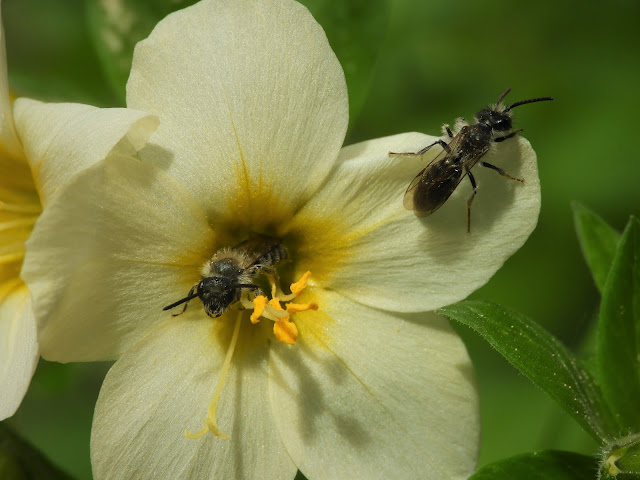
Andrena males on Polemoneum carneum near Pilot Rock (Ashland, OR)
There are roughly 550 species of Andrena in the United States and Canada, with at least 1500 species worldwide. At least 200 species are found in the Pacific Northwest. Andrena are found all around the world except Australia, South America, and Antarctica (there are no bees in the Antarctic circle). Most species are active in early spring, and there are a relatively small selection of species active in autumn. They are typically small, yet some species are roughly the size of a honey bee. The related species Perdita are the worlds smallest bees with the highest diversity in the Southwestern US and Northwestern Mexico. Some species of Perdita are smaller than mosquitos! The Andrenidae, the taxonomic family that contains Andrena, Perdita, and many other genera is the largest taxonomic bee family with 45 genera worldwide.
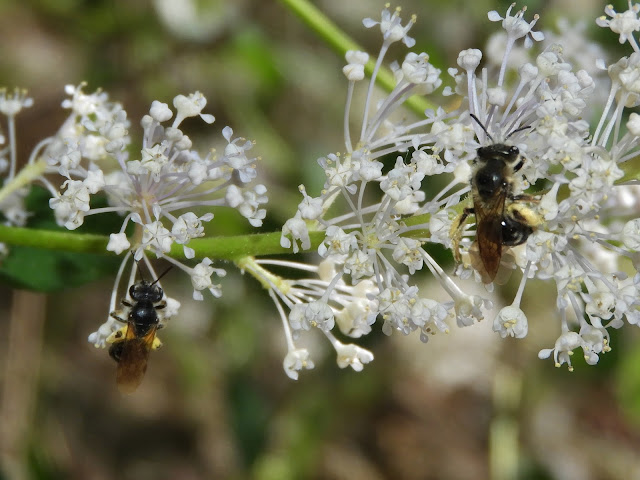
Two different sized Andrena females on Ceanothus integerrimus
The majority of Andrena species are univoltine, where there is only one generation per year. Some species are bivoltine with two generations per year. Most species go through their dormant period (winter in North America, though there are winter-active species overseas) in diapause as adults, which likely gives them the advantage of being able to emerge quickly once conditions are favorable. If environmental conditions are not ideal for the flowering plants they depend upon, some species have been known to remain in diapause for at least two years before emerging.
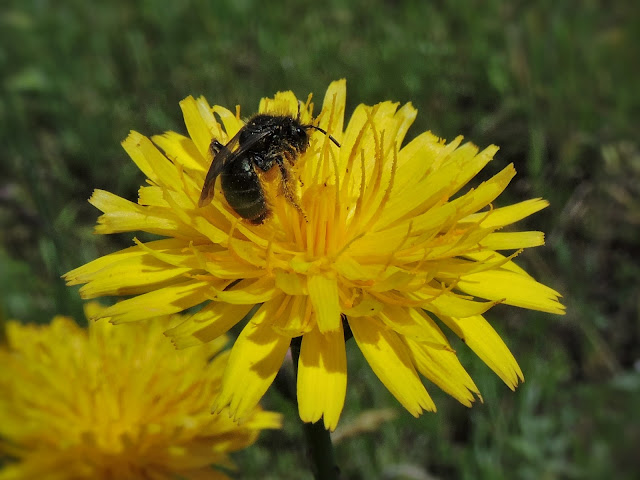
Andrena pertristis (?) on common dandelion
Most Andrena are solitary, every female excavates and provisions her own nests. Some species are communal and dozens of females will share a single nest entrance, but they still lay eggs in their own cells inside the communal nest. It's comparable to a New York apartment building, where neighbors share a front entrance but still have to buy all their own groceries. Some Andrena nest in large congregations where nest entrances may be as close as an inch apart. Nest entrances may be hidden under leaves or fallen branches, and nests may be excavated in various soil types (i.e. sand or clay).
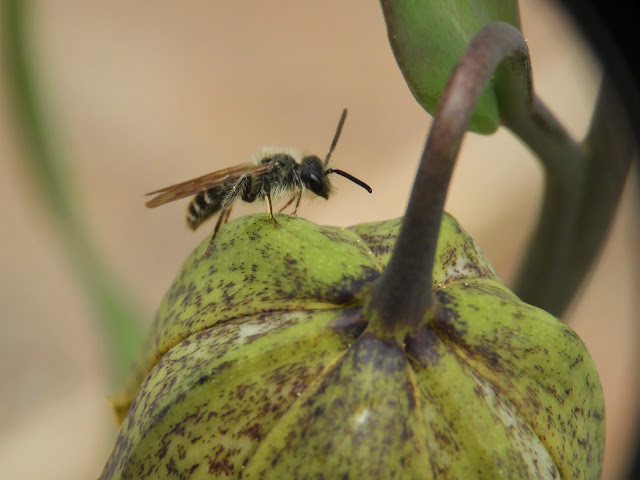
Male Andrena perched on Fritillaria affinis, near Pilot Rock
Unlike honey bees, Andrena excavate tunnels straight down into soil. They are very common in lawns and sometimes nest in soil covered by vegetation, unlike most other ground dwelling bees. Cells branch off the main shaft on short lateral tunnels. Nests of Andrena are typically between 6-12" (15-30cm) deep, but desert dwelling species nests can be incredibly deep. Andrena, like many solitary ground nesting bees, line their cells with a wax like substance produced from the Dufour's gland on the underside of the abdomen, and spread it around the cell wall with the trowel-shaped pygidial plate located at the tip of the abdomen. The waxy substance protects the larvae from bacterial infections and retains the moisture in the cell, reducing the risk of desiccation. Andrena also use the Dufour's gland secretions to mark the entrance of the nest to help them find the nest via the odor, especially important in communal nests where keeping intruders out is of great concern. Additionally, female Andrena scent-mark flowers with Dufour's gland secretions where resources were good so they may return on the next foraging trip.
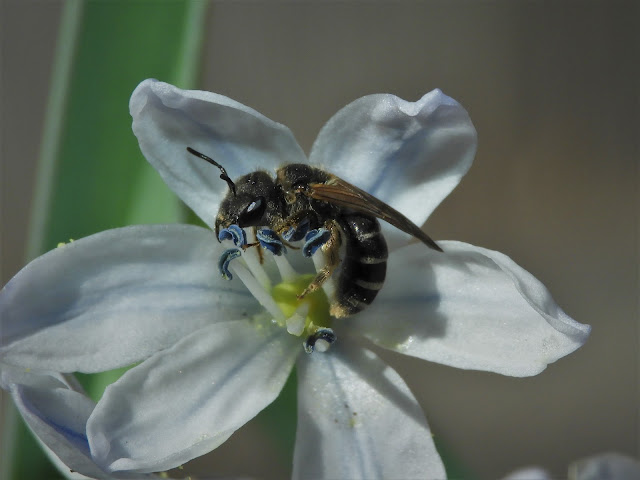
Andrena on February blooming Scilla mischtschenkoana in my garden
Early spring weather is sometimes unpredictable. Rainy and windy weather can make it difficult for early bees to forage for resources and provision cells. With all solitary bees, cell provisioning entails collecting pollen and nectar, mixing them to form a pollen ball, depositing an egg, and sealing the cell before starting on the next one. Andrena are typically slow to provision cells, sometimes only completing a single cell per day. On average, each foraging trip can take over an hour for some species to gather nectar and pollen for a cell, and an average Andrena cell takes roughly nine foraging trips to complete. Some of these foraging trips are used for the mother bee to feed on nectar for herself. Nectar and to a lesser extent pollen is the sole source of carbohydrates and nutrients for adult bees. Pollen is the sole source of proteins and amino acids bees need, especially important for developing larvae.
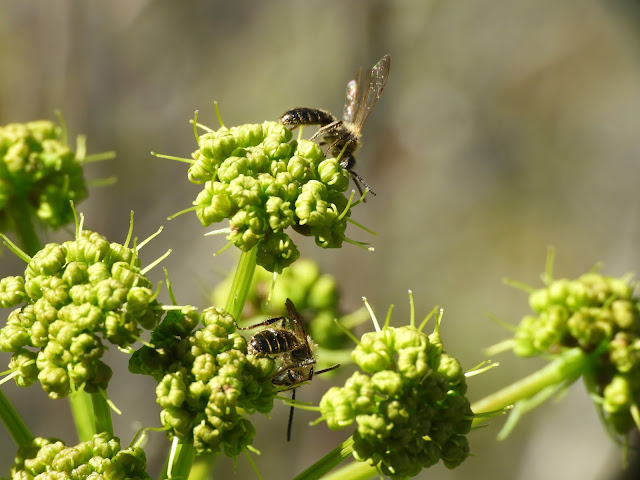
Lomatium californicum on Upper Table Rock with swarming male Andrena

Andrena are short tongued bees, and most forage for nectar on flowers with easily accessible nectar. Unlike honey bees and bumble bees which use their proboscis more like a straw, short tongued bees lap up nectar not unlike a cat. This doesn't mean all Andrena can't access nectar in larger or deeper flowers, some species have longer mouth parts or special adaptations that enable them to reach hidden nectar. Many species are pollen specialists and only collect pollen from a narrow range of plant species. For example, some Andrena species only collect pollen from Asteraceae (sunflower family), Apiaceae (parsley family), or willows (Salix spp.). The specialists will still collect nectar from a wider range of plants, including many nonnative plants. Most species aren't terribly picky, and some are important pollinators of cultivated plants in gardens and agricultural settings, though mining bees aren't commercially managed like alfalfa leafcutter bees or orchard mason bees.
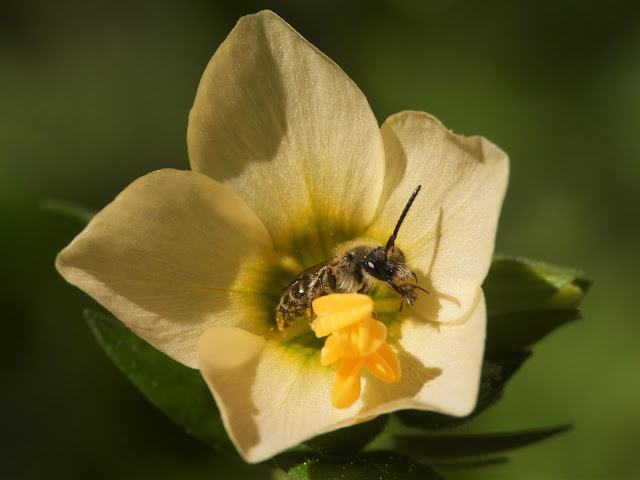
Male Andrena with extended proboscis
Like many of the solitary bees, male Andrena emerge from diapause before the females. Males do not actively collect pollen, but they do feed on nectar. While male bees are not usually often valued for their pollination services, male Andrena do serve important roles in the pollination of some plants like bee-mimic orchids (Ophrys spp.) in Eurasia and Northern Africa where the orchids live. The bee orchids are only pollinated by male bees who are duped into thinking the orchid is a female ready to mate, and they recieve nothing for their efforts. For most other plants, males may be superior pollinators on a per bee basis. Female Andrena collect much larger amounts of pollen than males, but most of that pollen goes to the nest instead of the next flower since females frequently and thoroughly groom the pollen into their scopae (specialized pollen carrying hairs). Males don't groom frequently, and on a per bee basis likely deposit more pollen than females. Males don't visit nearly as many flowers as females, and are generally smaller in size. The importance of any pollinator to a specific plant species depends on how effective each flower visit is in regards to collecting or depositing pollen, and the rate of visitation. On a net basis, females are more important pollinators for the majority of plants visited.
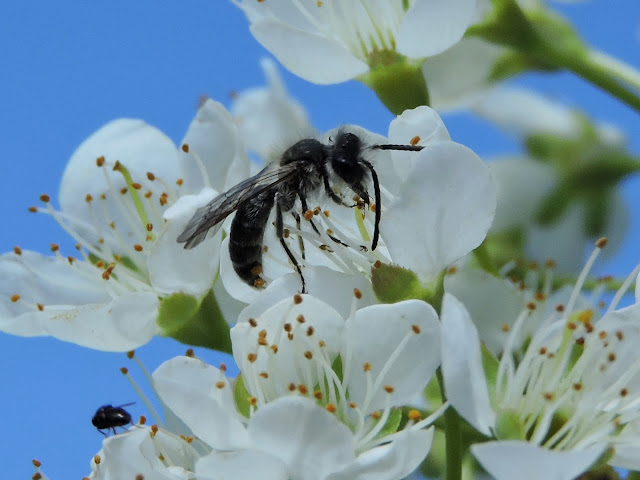
Plum blossoms with an Andrena male
Females collect pollen by grabbing onto the anthers with their legs and bending the abdomen to push the anthers onto their bodies. On some flowers they contact the anthers by default as a result of reaching for nectar. Female Andrena are usually active for much of the day when weather is favorable, and visit many more flowers than males. Between flower visits, female Andrena groom all of the pollen onto their hind legs. Scopae, the specialized plumose hairs used for holding pollen, are located on the hind leg tibia and extending all the way up to the trochanter and propodeum (where the hind leg meets the thorax). Andrena with a full load of pollen can appear to have a belt of pollen spanning between the hind legs.
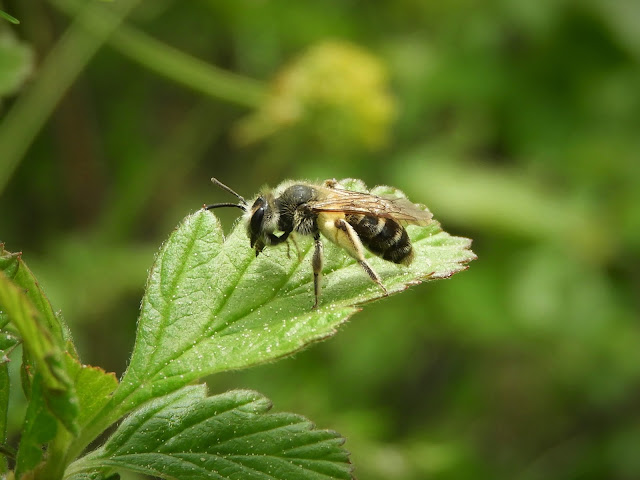
Female Andrena with pollen laden scopae
Flower visits by Andrena aren't always mutually beneficial. Some Andrena are nectar thieves of certain flower types, accessing the nectar without contacting the anthers or stigma and thus being of no benefit to the plant. Nectar is a metabolically expensive incentive plants make that is meant to attract pollinators to facilitate plant reproduction. Some plants keep the nectar hidden within parts of the flower inaccessible to some pollinators. This excludes the least effective pollinators for a particular plant species and encourages the best pollinators for the particular flower type (or at least that's how it's supposed to work). Many bees cheat by making incisions in the sides of the flowers to bypass the reproductive organs altogether and access the nectar directly.
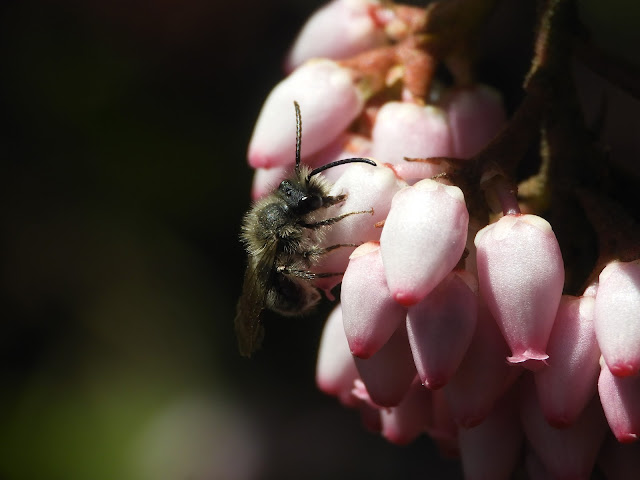
Male nectar thief stealing nectar from a slit in the side of a manzanita flower.
In my observations, male Andrena appear to steal nectar more often than females. With shallow flowers that don't exclude pollinators, like many of the Asteraceae and most fruit trees, this doesn't appear to be the case. Flowers on plants in the Ericaceae (i.e. Arctostaphylos; Arbutus), Berberidaceae (Epimedium), or Fumariaceae (Corydalis; Aquilegia), to name a few examples, often have either restricted openings in urn-shaped flowers or nectar filled spurs are often victims of nectar thievery. In the case of Arctostaphylos, and many other genera in the Ericaceae, the flowers are only pollinated by bees capable of sonication where the bees vibrate their wing muscles to release the pollen.
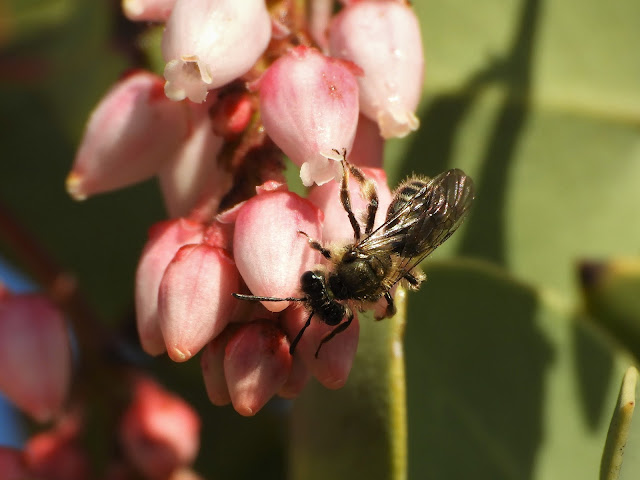
Manzanita flowers 
Manzanitas, the common name for Arctostaphylos, are one of the earliest blooming shrubs in the Rogue Valley, and they attract a wide range of pollinators, including many hungry Andrena. Bumble bee queens and anthophorine bees (Eucera sp.) use their mandibles to cut slits at the base of manzanita flowers. Smaller bees like Andrena then follow in their place. Most Andrena are not equipped to access the nectar from the flower opening unless the flower is damaged or malformed, and it is unlikely they contribute towards the pollination of Arctostaphylos in any significant way.
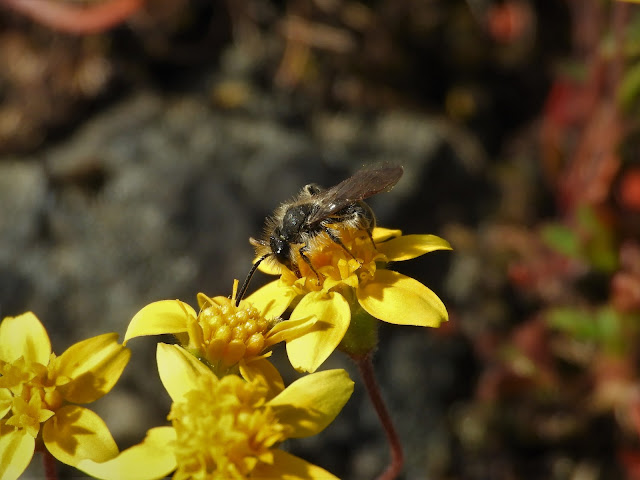
Lasthenia californica ssp. californica and male Andrena on Upper Table Rock
Despite being occasional nectar thieves, Andrena are very important early pollinators for many plant species. In some areas, they are the most abundant bee when the weather is cool. Although they are active in early spring in low elevations, they are active in early summer in higher altitudes such as subalpine and alpine mountainous environments. In either high or low elevations, Andrena can't warm their bodies the way that bumble bees do by vibrating their flight muscles and burning calories for warmth. All bees are ectothermic (cold blooded), while some bees, like bumble bees, are facultatively endothermic (having the ability to warm themselves). To cope with cool environmental conditions, Andrena sunbathe on sunny vegetation until their body temperature is adequate for flight.
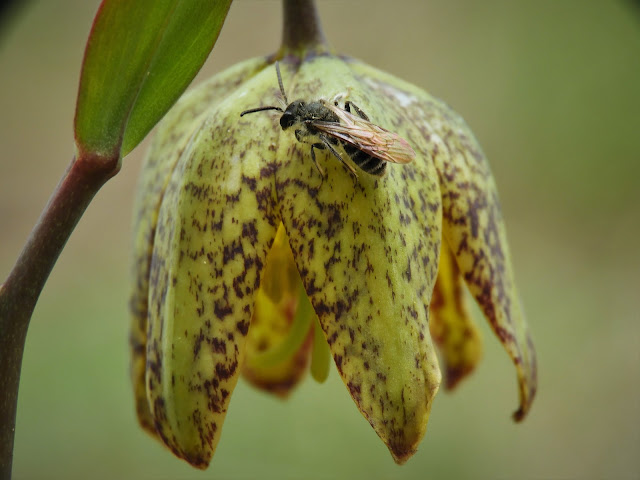
Fritillaria affinis with possible Andrena pollinator?
Most Andrena feed on nectar and pollen from a very wide range of plant types. While there are many specialist species, most are highly adaptable generalists. Species whose ranges span multiple ecoregions (such as A. prunorum which is found throughout most of the west in the United States and Canada) are not picky eaters, and may feed on completely different plant species in different parts of their range. There are species that collect pollen from many wind pollinated plants, like grasses and oak catkins. Planting flowers for Andrena in the garden is not challenging, so long as you include many species with open or small flowers. Some of the plants in my garden that I have observed Andrena visiting include bulbs (i.e. Crocus; Scilla), strawberries, Apiaceae (Lomarium; others), California lilac (Ceanothus), Berberidaceae (Epimedium; Mahonia), and many others. It's worth experimenting and observing to see what they like, but if you include a large diversity of flower shapes and overlapping bloom periods, there are good odds you'll see some Andrena.
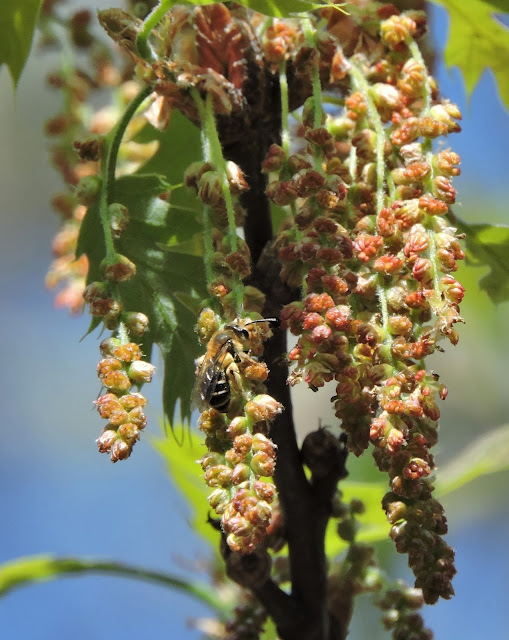
Andrena female gathering pollen on oak catkins, I was very excited to capture this photo!
If you don't detect any Andrena in your area, they may be detected by the presence of some of their parasites. The fuzzy bee-like beefly (Bombylius) is a nest parasite of many ground nesting bees. They have a long needle-like proboscis and visit many of the same flowers as Andrena. Beeflies hover over the ground looking for bee nests, and when one is detected, they skillfully toss some eggs into the nest with a flick of their abdomen, all while remaining in flight. Another group of nest parasites are the cuckoo bees in the genus Nomada. Nomad cuckoo bees are very wasp-like in appearance, often in bright colors like red. While these waspish bees don't collect pollen, they feed on many of the same nectar plants as Andrena and may play a small role in pollination. There are others, and the presence of any of these parasites is a sign of a healthy host population.
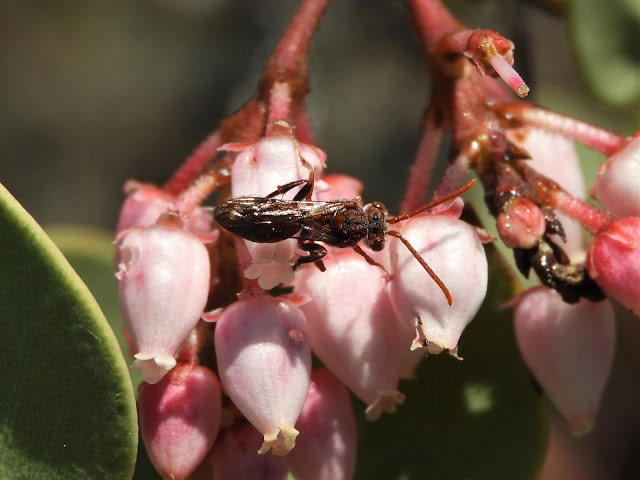
Nomad cuckoo bee (Nomada)
I hope you enjoyed reading this introduction to the mining bees, Andrena. This wasn't meant as an identification guide, and there is much more that I could have written to further illuminate the biology and behavior of this large genus. If you would like to learn more, please take a look at some of the resources below.

Sources:
Danforth, Bryan. The Solitary Bees: Biology, Evolution, Conservation. 1st ed., Princeton University Press, 2019.

Fowler, J. (2020). Pollen Specialist Bees of the Western United States. https://jarrodfowler.com/pollen_specialist.html

Michener, Charles. The Bees of the World. 2nd ed., Johns Hopkins University Press, 2007.

Miliczky, Eugene. “Observations on the Nesting Biology of Andrena (Plastandrena) Prunorum Cockerell in Washington State (Hymenoptera: Andrenidae).” Journal of the Kansas Entomological Society, vol. 81, no. 2, 2008, pp. 110–21.

O’Toole, Christopher. Bees: A Natural History. First Edition, Firefly Books, 2013.

Stephen, William Procuronoff, et al. The Biology and External Morphology of Bees. Amsterdam University Press, 1969.

Tang, Ju, et al. “Pollinator Effectiveness and Importance between Female and Male Mining Bee (Andrena).” Biology Letters, vol. 15, no. 10, 2019, p. 20190479.

Wilson, Joseph, and Olivia Messinger Carril. The Bees in Your Backyard: A Guide to North America’s Bees. Princeton University Press, 2015.

U

Thursday, May 27, 2021

Bumble Bees of Vesper Meadow

Bombus vandykei on a native Phacelia
Bumble bees are some of the most conspicuous of the bees. Fast flying, buzzing balls of fuzz hurtle from flower to flower and can bee seen, or heard, from a distance. This may be part of why they are many folks favorite bees. While I could never choose a favorite bee, bumble bees are charismatic and fascinating. While the United States boasts around 40 species of Bombus (the genus to which bumble bees belong), there are roughly 30 species native to just the Pacific Northwest (Idaho, Oregon, and Washington). At least 15 species call Southern Oregon home, and many of these have been identified from the Vesper Meadow Restoration Preserve in Ashland.

Prime bumble bee habitat: Wyethia angustifolia blooming in part of the Vesper Meadow Restoration Preserve

Vesper Meadow Restoration Preserve

Vesper Meadow is a privately owned 403 acre upland wet meadow in the heart of the Cascade-Siskiyou National Monument. The Vesper Meadow Education Program, which operates at the meadow and surrounding forest acreage, brings together scientists, students of all ages, and the public to study the local ecosystem and cultural significance of the land. One of the goals of the Preserve is to monitor wildlife of all sorts, from birds to plants to insects. Pollinators, especially butterflies and bees, are also being documented and monitored by organizing focused bioblitzes. Typically taking place over the course of a single day, a bioblitz is when a group of volunteer citizen scientists attempt to record as many living species as possible in a given area.

Bombus vosnesenskii on Solidago at Vesper Meadow
2021 Bumble Blitz at Vesper Meadow

Vesper Meadow is hosting a targeted bumble bee survey on Sunday, June 27th (from 10:00am to 2:00pm). This will be the second annual Bumble Blitz. Attendees will learn the basics of bumble bee identification, how to net a bumble bee, become acquainted with some of our native flora, and contribute to science! Also, it's beautiful there. Get some fresh air, meet fellow bee nerds, and enjoy the wilderness. If you plan on attending, please RSVP on the Vesper Meadow website.

Bombus flavifrons on Agastache urticifolia

Bumble Bees 101

I will now provide a basic introduction to some of the bumble bees we've identified from Vesper Meadow. But first, a little about bumble bees. Bumble bees (genus Bombus) are cousins of the honeybees (genus Apis). Bumble bees are found around the world in temperate regions, most north of the equator (with the exception of South America where a handful of species are found), with the highest species richness from the Tibetan Plateau westward to the Alps. Most species are eusocial, like honeybees, except a smaller proportion of species which are social parasites (subgenus Psithyrus, they expropriate established nests of non-parasitic species for their own reproductive gains). In contrast, honeybees aren't native to the Americas and the genus Apis contains no social parasites.

Bombus californicus on Wyethia angustifolia
Bumble Bee Life Cycle

Bumble bee colonies have an annual lifecycle. At the start of the season (anywhere between spring and summer, exactly when depends on the species) a queen emerges from her hibernaculum and seeks both nourishment from flowers and an abandoned rodent burrow or grass tussock to initiate a nest in. Once she finds a suitable nest location, she rears a batch of miniature workers which take over some of the foraging duties of the queen, allowing her to remain in the nest more and more. Eventually the colony has many workers (between 50 and 500, though usually less than 100) and the queen remains in the nest for the rest of her life. Towards the end of the lifecycle of the colony, new queens and drones (males) are produced, which leave the nest to find mates from other colonies. Following mating, the drones die and the newly mated queens seek a place to shelter over winter. The original colony and queen dies, and only the new queens last the following year to renew the cycle.

Bombus bifarius s.l. (B. vancouverensis nearcticus)
Vesper Meadow Bumble Bees

I've caught at least seven species of Bombus at Vesper Meadow, in addition to perhaps three or four additional species which have yet to be identified. Bombus californicus (syn. fervidus), flavifrons, melanopygus (syn. edwardsii), mixtus, nevadensis, vancouverensis nearcticus (syn. bifarius s.l.), and vosnesenskii have all been identified, yet caliginosus and vandykei (very close mimics of vosnesenskii) may possibly be found at or around Vesper Meadow. The white-shouldered bumble bee, B. appositus, is also found in the area (likely at Vesper Meadow) but it is uncommon. Additionally, there has been a single sighting of the Western bumble bee, B. occidentalis, but no sightings since to my knowledge.
Bombus flavifrons
There also may be one or two of the socially parasitic bumble bees, subgenus Psithyrus, though no sightings or specimens have been confirmed as of this writing. The Oregon Bee Atlas expects to find the Fernald cuckoo bumble bee (B. fernaldae, syn. flavidus) and the Indiscriminate cuckoo bumble bee (B. insularis) in Oregon, but very few specimens have been vouchered. Social parasitic bumble bees have only two castes, female ("queens") and male, unlike other bumble bees which have queens, workers, and males. Rather than building their own nests, Psithyrus females (not technically queens since there is no worker caste) invade established nests and take them over, using the host workers to rear her young. This results in killing the colony since workers are no longer produced, only reproductive males and females of the social parasites. This seems harsh, but their presence would indicate a healthy host population. Psithyrus females can be identified by having no corbiculae.

Species Accounts

The following are a selection of bees I've photographed or collected for the Oregon Bee Atlas and Vesper Meadow Bumble Blitz. For the Bumble Blitz, we will be using the capture, chill, release method. This involves netting bees, putting them in vials, and chilling them in a cooler so we can take detailed photos of them for identification. This is in contrast to netting bees, placing them in a kill jar (it's more humane than it sounds), and pinning them for identification under a microscope. Both collection methods have pros and cons. There are some bees that are very difficult to identify in the field, which is where pinned specimens may be superior. However, catch-and-release doesn't come with any moral ambiguity. As you will notice, photos don't always capture every characteristic necessary to assuredly identify some species. The best advice is to take as many good photos as possible, and hope you've captured the right angles.

White-Shouldered Bumble Bee - Bombus appositus

Bombus appositus
The white-shouldered bumble bee, Bombus appositus, has a general appearance of being well groomed with short, even hair all over. As the common name suggests, this bee has white patches on the anterior of the thorax, with a black band between the wing bases. The face and posterior of the thorax is either white or yellow, with the abdomen completely yellow or tawny buff. The white-shouldered bumble bee nests both underground and on the surface, such as within dense grass tussocks.

California Bumble Bee - Bombus californicus

Bombus californicus
Bombus californicus (syn. B. fervidus californicus) is very similar to both vosnesenskii and vandykei, all are black with yellow bands on the thorax and a yellow band of hair towards the tip of the abdomen on the third or fourth segments (also called tergites). B. californicus differs from the lookalikes by having a completely black head and a cheek longer than broad. They nest on the surface or aboveground, occasionally underground. Nests may be found in haystacks, abandoned mouse nests, or birdhouses. They are said to be one of the more aggressive species, most likely when nests are disturbed.

Yellow-Fronted Bumble Bee - Bombus flavifrons

Bombus flavifrons female
Bombus flavifrons females are usually characterized by yellow and black hairs intermixed on the face, and intermixed yellow and black on the anterior of the thorax. The first two tergite have yellow bands while the third and forth tergite have either orange or black. The forms I've seen at Vesper Meadow usually have black bands with few orange hairs intermixed, appearing dull orange. Similar to californicus, they have a relatively long cheek (malar space longer than wide).
Bombus flavifrons male
In contrast to females, male flavifrons are almost entirely yellow or sometimes have black or orange hairs intermixed in the last few tergites. This species nests primarily underground, utilizing abandoned rodent burrows.

Fuzzy-Horned Bumble Bee - Bombus mixtus

Bombus mixtus
Bombus mixtus has yellow and black hairs intermixed on the face and thorax. The first abdominal tergite is always yellow, followed by a black band and the fourth/fifth tergites orange, sometimes appearing dull and intermixed with yellow hairs. B. mixtus is sometimes known as the fuzzy-horned bumble bee because the males have tufts of hair jutting from their flagellum (segments of the antennae), though they're only visible at certain angles under magnification. They are flexible in their nesting locations, nesting above- and belowground.

Black-Tailed Bumble Bee - Bombus melanopygus (syn. edwardsii)

Bombus melanopygus (syn. edwardsii)
As seems to be the case with many of the Western bumble bees, Bombus melanopygus has two distinct color morphs. The morph pictured here has no orange, and is sometimes considered a separate species, B. edwardsii, depending on the authority. The black-tailed bumble bee, B. melanopygus, is so named since the last tergite is always black. The hairs on the head are usually yellow or yellow intermixed with black. Similarly, the anterior of the thorax is mostly yellow with black intermixed, followed by a black band, with yellow hairs on the thorax posterior. Note that the corbicular fringes are mostly black (compared to vancouverensis nearcticus which has orange corbicular fringes) The abdomen always has yellow on the first tergite, usually followed by orange on the second and third tergites.
Bombus melanopygus (syn. edwardsii)
The Bombus edwardsii color form of melanopygus replaces orange with black on tergites two and three. The fourth and fifth tergites have yellow creeping inwards from the sides. B. vancouverensis nearcticus is very similar to the edwardsii color form, but nearcticus (almost) always has black on the last two tergites in females. The black-tailed bumble bee nests wherever, in birdhouses, housing insulation, abandoned rodent burrows, or wherever they deem fit.

Nevada Bumble Bee - Bombus nevadensis

Bombus nevadensis queen
Bombus nevadensis is similar to B. griseocollis which is more common at lower elevations. B. nevadensis has a look of being clean cut. It seems more brown than yellow compared to other bumble bees in the area. Hair on the face is usually black, sometimes with a few yellow hairs intermixed. There is usually a black spot or band between the wings with many intermixed yellow and black hairs around it. The sides of the thorax are black. The second and third tergites always yellow, while the first tergite is either black or yellow. The last few segments are always black, except for males which have orange at the tip. These large bees are most often ground nesters.

Two-Formed Bumble Bee - Bombus bifarius s.l. (syn. vancouverensis nearcticus)

Bombus vancouverensis nearcticus (syn. B. bifarius s.l.)
Bombus vancouverensis nearcticus (sometimes shortened to B. nearcticus) and v. vancouverensis were recently split from bifarius, the two-form bumble bee (see Ghisbain et al 2020). According to genetic analysis, bifarius s.s. is restricted to the Colorado Plateau and surrounding regions east of the Rockies, while vancouverensis nearcticus is found from the San Juaquin Valley in California and as far north as British Colombia. The third species, v. vancouverensis is restricted to Northwestern Washington and Southwestern B.C. If you don't follow, don't worry. Oregon only has v. nearcticus, which has no orange on the abdomen, while both bifarius s.s. and v. vancouverensis both have red.
Bombus vancouverensis nearcticus
Bombus vancouverensis nearcticus has a characteristic black notch in the center of the yellow band on the posterior of the thorax. There is a yellow band on the fourth tergite while the fifth and sixth tergites are always black. Compare with edwardsii (syn. melanopygus) which has yellow on the sides of the fifth tergite. This species will also have orange fringes on the corbicula while edwardsii will usually have black hairs, sometimes tipped with orange. The two-form bumble bee is primarily an underground nester, though they occasionally nest on the surface.

Yellow-Faced Bumble Bee - Bombus vosnesenskii

(including descriptions for vandykei and caliginosus)

Bombus vosnesenskii
Bombus vosnesenskii, vandykei, and caliginosus are all incredibly similar. All three have yellow faces and yellow shoulders, with a yellow band on the abdomen. With vosnesenskii and caliginosus, the yellow abdominal band will be on the fourth tergite while vandykei will have the yellow band on the third tergite. Where in vosnesenskii the sternum (underside of the abdomen) will be entirely black, caliginosus will have pale yellow fringes on the fourth sternite. I've also noticed that vandykei males are often completely yellow and probably indistinguishable from male flavifrons. Both vosnesenskii and vandykei nest underground, while caliginosus will nest underground or in abandoned bird nests.

- - -

Thanks for taking the time to read this. This is no substitute for a proper identification guide, but rather an attempt at an introduction. I hope you can make it to the 2021 Bumble Blitz, so if you can please RSVP!

Learn more about Bumble Bees:


Wednesday, April 7, 2021

Table Rock Revisited

Spring is the best time of year to hike up either of Southern Oregon's Table Rocks. The sky is blue and fresh, life has returned to the land after a grey winter, and the humming of insects fills the air. Flowers are the jewels of the experience, since they are the epitome of Spring.
A mining bee (Andrena)
Part of what makes Upper Table Rock enjoyable to hike is that it's relatively quick and easy, not to mention very close to where I live. It takes less than an hour to reach the top of the mesa. Of course, with my camera I tend to stop and snap a few photos every time I see something interesting so it often means I spend most of the day exploring.
Erythronium hendersonii
Shortly after setting out on the trail, Erythronium hendersonii takes center stage. It was in bloom as far as I could see in the forest understory on the first half of the ascent. I advise getting on your hands and knees to check out the intricate floral markings! These nectar guides may help bees (the primary pollinators of Erythronium) find the nectar reward at the intersection of the petals.
A carpet of Erythronium
Inexplicably, bees were largely absent from most of the flowers lower on the trail. A few factors may have contributed to this. The manzanita was blooming further up the plateau, and the bumblebee queens which I suspect are the primary pollinators of erythroniums here were busy looking for suitable nest sites. One can only imagine.
Apis mellifera
As I continued to ascend the trail, honey bees became more prevalent on the erythroniums. Perhaps they've replaced the ancestral bumblebee pollinators. Maybe the bees which once pollinated E. hendersonii are now extirpated. Ranges of species change all the time, at least in evolutionary timescales. Many species of bumblebees have been seeing declines in recent decades due to habitat loss and diseases spread by introduced species. This is purely conjecture.
Honey bees appear to be adequate pollinators of E. hendersonii. The stigma is situated in a way that simply jostling the flowers (such as a bee landing on the stamens) may cause some pollen to move around. Most of the erythroniums that I've encountered in the Rogue Valley set seed every year despite potentially low numbers of pollinator visits. This apparent ability to set seed easily may be an adaptation to unpredictable spring weather. It's around this time of year that rain becomes an oddity and the next time water falls from the sky is autumn. Time to dry out.
Protosmia rubifloris ♂ hiding in Ranunculus occidentalis
The abundance and variety of bees now is astonishing. Protosmia is an osmiine bee (Megachilidae, leafcutter, mason, and resin bees) that nests in above-ground cavities. Records of nest sites is sparse, but some species have been known to make nests in things such as pine cones and snail shells! Another trait that makes Protosmia fascinating is that they overwinter as adults, uncommon in the Megachilidae. Their nests are capped with an excreted resin. Another peculiarity is that not all bees favor buttercups (Ranunculus spp.), and the pollen is even toxic to some bees.
Anthaxia aff. inornata
It is likely beetles are often overlooked as pollinators. They're not as efficient, or perhaps charismatic, as bees. Beetles were pollinating gymnosperms like cycads at least 200 million years ago, at least 75 million years before angiosperms (flowering plants, plants most adapted to bee pollination) and bees every appeared in the fossil record. Many flower-visiting beetles don't travel from flower to flower as frequently as bees, but there are some with densely haired bodies which are important pollinators of some plant groups (including many of the large-flowered tulip species), many bearing bowl shaped magnolia-like blossoms.
Flower longhorn beetle (Cortodera)
Beetles visit flowers for a variety of reasons, though I don't know of any beetles that collect pollen for rearing young. Many beetles eat pollen, nectar, or the flowers themselves. In other instances, beetles congregate at flowers to mate. There are also parasitoid beetles which lay eggs on or near flowers, the larvae attaching themselves to bees to hitch a ride to the nest where they feed on the provisions supplied by the bee or the bee larvae.
Ranunculus austro-oreganus
Southern Oregon buttercup (R. austro-oreganus) are endemic to, unsurprisingly, Southern Oregon (specifically Jackson County, according to the NRCS). They are slightly larger than R. occidentalis, and they have reddish veins on the back of the petals. Upper Table Rock hosts a vigorous population on the first half of the trail.
A hidden Lasioglossum ♀ forages on Southern Oregon buttercup.
I'm always intrigued by bees that visit buttercups. Many of the bees that collect ranunculus pollen are specialists, and the pollen would be toxic to many bees unable to metabolize it (Praz et al. 2008). That said, seeing a bee on a buttercup seems like something special. Pollen specialists need the pollen from their host plant in order to rear the next generation, which elucidates why maintaining a healthy balanced ecosystem is so crucial. Lives literally depend on diversity.
Fritillaria recurva
One plant that always results in a gasp is the beautifully checkered Fritillaria recurva, sometimes called red bells. Upper Table Rock sports a scattered population of the gloriously red bulbs. I have never once seen pollinators of any kind visit the flowers, but it isn't terribly surprising since I have never seen more than a dozen of them flowering in one place. Pollinators, particularly bees, are generally most attracted to large patches of flowers of the same species. The most F. recurva flowers I have seen in one place is maybe a little over a dozen. Besides all that, the morphological characteristics of the flowers suggest Ornithophily (bird pollination). Red tubular or bell shaped flowers with dilute nectar and slightly protruding stamens fits the bill. [Pun was accidental]
Fritillaria recurva is one of the most graceful native wildflowers, and it's always a treat to find in the wild. I hope to someday see a hummingbird visiting the flowers, but due to a lack of photos of pollination events on the google, I may be in for a bit of a wait.
Habropoda depressa ♂ on Cynoglossum grande
Another woodland favorite is the Pacific hounds tongue (Cynoglossum grande); a bigger, sexier version of the familiar forget-me-not (Myosotis) grown in cottage gardens. Being a member of the Boraginaceae (you guessed it, the borage family), it has white fornices (the white appendages at the "eye" of the flower, sing. fornix) and hidden anthers. Bees collect pollen by sticking their tongues in the flower, and some have specialized hooked hairs on various parts of the proboscis for this purpose.
Habropoda depressa ♂
Habropoda depressa, sometimes known as mountain digger bees, are some of my favorites. As the name suggests, they are solitary ground-nesting bees. Despite being solitary, they nest in large congregations. Males are the first to emerge, so the first to see foraging for nectar as they wait for the females. As the unfortunate females emerge a week or two after the males, they are balled by thirsty males trying to mate. I observed such an occurrence recently. The males numbered probably a dozen per female, and females couldn't even get off the ground before being mobbed. This doesn't appear to hurt the bees, despite some grappling between males, and they seem to have very healthy populations here.
Andrena on Lomatium urticulatum
Mining bees (Andrena spp.) are the most common spring bees on Upper Table Rock. Spring gold (Lomatium urticulatum) is the first of the buscuitroots to bloom, sometimes starting in mid February. Small bees and flies are quite smitten.
Formica
Ants are one of the least likely pollinators, despite many species seeking nectar on a huge variety of plants. Their ability to be good pollinators is sometimes hindered by pollen-destroying excretions on the exoskeletons of some species. Many ants produce antibiotic compounds needed to keep pathogenic microorganisms out of the nest. Pollen that comes into contact with these compounds is often no longer viable, and ant pollinated plants see a decreased seed set when compared to bee pollinated plants. See Beattie et al. 1984.
Andrena males on Lomatium californicum
Larger lomatiums grow in clearings along the trail on Upper Table Rock. The inconspicuous green flowers are highly sought by small mining bees. Andrena are short tongued bees, having relatively short labial palpi and glossa (for detailed diagrams of bee mouthparts see Bee Anatomy, it's a European bee ID website but the diagrams are good for all bees). The glossa can be thought of as the true tongue, the part that laps up nectar. In general, short tongued bees need flowers with easily accessible nectar and shallow flowers. Lomatiums and many genera in the Apiaceae (carrot family) offer numerous small flowers which are attractive to many small beneficial insects.
Andrena ♂
Andrena are mostly solitary, but many are thought to be communal. This means the females share a nest entrance but dig and provision their own cells which radiate laterally off the main burrow. Andrena line their cells with a wax-like substance, possibly to keep water or pathogens out. Males are sometimes seen before females, but they both usually emerge at the same time. Both male and female overwinter as adults, though the females mysteriously hide after mating, perhaps returning to the burrow to start digging cells. Andrena are univoltine, meaning one generation is produced per year. More on Andrena later.
Micranthes integrifolia with a fly
Micranthes, formerly Saxifraga, is seen periodically on both Table Rocks. It appears to be attractive primarily to various flies, as I suspect most saxifrages are.
Buckbrush (Ceanothus cuneatus)
At the time of my hike on Upper Table Rock, the buckbrush was just about to bloom. (By thy time I finish writing this, the bloom will probably be passed.) The very first of the musky smelling ceanothus blooms were attractive to honey bees. The only open buds were on the sunny south side of the shrubs. Sunlight is a key indicator to many plants that it is time to bloom, be it day length or plain old warmth.
Birch leaf mountain mahogany (Cercocarpus betuloides)
I've probably walked by these trees in bloom a hundred times in complete ignorance. The greenish inconspicuous flowers of mountain mahogany were attractive to bumble bees and honey bees, and the buzzing was the only indicator to me that they were blooming.
A honey bee grooms pollen into her corbicula
The ten to twenty foot tall trees periodically grew along the Upper Table Rock trail. Mountain mahogany is common in the Western states, growing in dry mountainous habitats from Canada south to Mexico. The seeds are very distinctive, and I've seen them for years not knowing what made them. Mountain mahogany seeds float down with a spiraled fuzzy tail, similar in function to the wings on maple seeds, aiding the seeds in spiraling away from the parent plant. Upper Table Rock trail in the fall is teeming with the peculiar curly-tailed seeds.
California sandwort (Minuarta californica)
Upon reaching the top of the mesa, I was rewarded with a carpet of miniature blooms spanning as far as I could see.
Apis mellifera
Bees were everywhere. I had seed the occasional honey bee, but the vast majority of the bees on the summit were small native bees. Every time this honey bee landed on a flower it bent it over.
Andrena
The majority of bees on the top of Upper Table Rock were small natives, mostly Andrena. These small bees, roughly half the size of a honey bee, are completely silent in flight. Honey bees, in contrast, are noisy and buzz every time they fly. This is a common phenomenon when comparing colony-forming Hymenoptera with solitary Hymenoptera. Colony forming bees (i.e. honey bees, bumble bees) and wasps (i.e. yellowjackets) are noisy and conspicuous, often brightly colored. This is an aposematic warning to would-be predators that they can and will defend themselves.
Andrena
Solitary bees (i.e. mining bees) and wasps (i.e. braconids) are often quiet in flight, and often have dull colors. These bees would rather flee than fight. Compared to honey bees, many solitary bees have relatively little invested in their nests and can readily relocate, abandoning a compromised nest. Nests of honey bees, bumble bees, and yellowjackets (among others) are full of hard earned resources (i.e. wax/paper comb) and multitudes of developing larvae. If these social Hymenoptera were forced to abandon their nests, it may be a death sentence. Solitary bees, like Andrena, aren't well equipped to defend the nest from large predators, so they don't advertise it.
Andrena
Andrena collect pollen dry, without mixing it with nectar like honey and bumble bees do. Specialized hairs called scopae are found on the back legs of Andrena all the way from the tibia all the way up to the propodeum (the rear, bottom portion of the thorax). Pollen appears to wrap around the underside of their waist, like a belt. While this dry collected pollen has a better chance of becoming dislodged on a flower (unlike wet honey bee pollen), it is estimated that less than 5% of the pollen is used for pollination. That means that at least 95% of the pollen collected by bees is eaten. This makes me wonder, do plants even want bees to collect their pollen?
Andrena ♂
Male Andrena were common at the time of my hike. Their long antennae are used to detect potential mates. Males don't collect pollen, and their utility as pollinators is questionable. However, we can thank the males for creating the next generation of Andrena! Thanks guys. Your bee-havior has not gone unnoticed!
Lasioglossum (subg. Lasioglossum)
Sometimes known as the sweat bees, Lasioglossum are probably the most abundant and diverse bees in North America, often very small and inconspicuously colored. They range in sociality from true solitary to primitive eusociality, sometimes varying geographically possibly in response to resource availability. Nearly all Lasioglossum nest in the ground, and some can have multiple generations a year with some overwintering as adults and some overwintering as larvae. There is a lot of mimicry between species which can make identifying Lasioglossum to species very challenging, something I hope to get better at this year.
Lasthenia californica ssp. californica with male Andrena
More Andrena on dwarf daisies on Upper Table Rock, shocking! The common name for Lasthenia, goldfields, is extremely accurate. Large swaths of golden honey-scented daisies carpeted the mesa summit intermixed with California sandwort. Goldfields vary in height from less than two inches up to fifteen inches depending on the soil. The soils atop the Table Rocks is thin and probably deficient in nutrients, resulting in dwarf versions of otherwise foot-tall flowers. L. californica is native throughout the West Coast from Southern California to Southwestern Oregon, mostly on the western halves of the states.
Andrena
It would be interesting to learn whether different species of Andrena prefer different plant species blooming concurrently. I didn't collect any specimens during my hike, but it would be interesting to investigate in the future. Many Andrena are pollen specialists of Asteraceae and even single genera or species. Pollen specialist means the females collect pollen from a narrow range of genera or species, but may collect nectar from a wider array of plants. Goldfields (Lasthenia) are host plants to at least a few species of Andrena (see Thorpe and Leong 1998).
Plagiobothrys aff. nothofulvus
Popcorn flowers, Plagiobothrys spp., are host plants for a ton of native pollen specialist bees in Oregon. I saw many patches of popcorn flower in various parts of the Upper Table Rock hike. I didn't see any bees, but I didn't observe for long. Pollen specialists of many members of the Boraginaceae (the forget-me-not family) have special adaptations for collecting the pollen hidden in the flowers. Some of these bees have velcro-like tongues with specialized hooked hairs on the proboscis. So cool!
Allium parvum
One of the treats I always look forward to on Upper Table Rock are the diminutive onion flowers which sit on the ground, often against volcanic stones. Allium parvum is a tiny onion with pea-sized bulbs. The leaves are often dead or dying by the time the flowers open.
Collinsia sparsiflora
Another dwarf version of an otherwise taller species, the odd-named spinster's blue-eyed Mary. In better soils, these plants can grow up to a foot tall, though on the thin rocky soils of Upper Table Rock they are less than two inches. Small three-square foot patches variously carpeted the mesa summit. Oddly, I witnessed no bees on these flowers. Peculiar.
Cowbag clover (Trifolium depauperatum var. depauperatum)
I'm always amused by the tiny red cow-udders of cowbag clover (sometimes called poverty clover). I've never observed pollinators visit this diminutive one inch plant, but they delight me nonetheless.
Lithophragma aff. parviflorum
Woodland stars, Lithophragma spp., are small scented flowers in the Saxifragaceae. They are pollinated primarily by invariably dull Greya moths. The moths are usually grey or white, and quite slender.
Olsynium douglasii
Grass widows, Olsynium douglasii, are relatively large beautiful flowers in the Iridaceae (related to Iris, Crocus, Crocosmia, and others). They are often the first blooms found on the top of Upper Table Rock, growing up to twelve inches. Oddly, I've never witnessed bees visiting the flowers despite seeming very attractive. Large bees like bumble bee queens are probably important pollinators for grass widows. An interesting feature of O. douglasii is that nectar is excreted directly from the filaments (stamens). (See Rudall et al. 2003)
Limnanthes aff. floccosa
Meadowfoam, the source of one of my favorite varietal honey, was here and there on the Upper Table Rock summit.
Chickweed monkeyflower (Erythranthe alsinoides)
Monkeyflower likes growing where seeps or springs keep the soil wet. I don't often see bees visit these plants, but they're popular with mason bees (Osmia spp.) where I've surveyed for bees.
Vernal pool
One of the features of both Table Rocks are the many vernal pools, home to tiny freshwater fairy shrimp (Branchinecta lynchi). By summer, the pools are completely dry. The miraculous lifecycles of the minuscule shrimp contend with this by going into a type of dormancy. Mosses and various plants like to grow on the margins of these pools allowing bees and other insects to safely land and drink.
Garter snake (Thamnophis sirtalis)
The vernal pools are hotspots for a variety of wildlife. I was surprised to find a garter snake hidden in the marshy grasses!
Burrow entrance of mountain pocket gopher (Thomomys monticola)
Undoubtedly, garter snakes and other predators hunt the various vermin that call the Table Rocks home. Gophers serve an important role on the mesa, tilling the soil and creating perfect soil beds for seeds to germinate. Many native plant seeds need direct soil contact as well as sunlight to germinate.
Dog tick (Dermacentor variabilis) ♂
With vertebrates come parasites. Ticks are an unfortunate risk when hiking, and it's important to be on the lookout. You can reduce your risk of picking up a tick by staying on the trail and thoroughly checking your clothes and body before you get in your car and when you get home. Ticks are like tanks and can survive for days or even weeks without food or water, even in extreme heat. I once kept a tick in a sealed jar on my dashboard in summer, the thing survived for a week!
Sayfly (Tenthredinidae)
Sawflies are related to bees and wasps, are are probably most similar to the ancestral predecessors of all Hymenoptera. Most sawflies feed on plant material, but adults occasionally feed on carbohydrate-rich nectar.
A view of Mount McLoughlin midway up the Upper Table Rock trail
Upper Table Rock trail is not very long or difficult, but it's worth taking your time to view the surrounding infrastructure surrounding the Table Rocks. Farms and ranches contrast with the nearly pristine landscapes flanking the trail. It's a bit sad.
White leaf manzanita (Arctostaphylos viscida) and honey bee
Manzanita bloom was starting to peak at the time of my hike. The highest diversity of bees could be found on these large shrubs. Honey bees might not be the best equipped to pollinate the flowers or reach the nectar due to the constricted urn-shaped flowers. Poricidal anthers keep pollen restricted only to bees that can sonicate, or buzz pollinate, the flowers. Sonication is when the bee grabs onto the flower and vibrates the flight muscles, a feat honey bees haven't evolved to do.
Habropoda depressa ♂
Mountain digger bees, Habropoda depressa, can and do sonicate flowers. White-leaf manzanita are commonly visited by the bumblebee-sized digger bees.
Nomada aff. erigeronis
Nomad cuckoo bees (Nomada spp.) are beautiful red kleptoparasites of Andrena and other solitary bees. They are in the Apidae which encompasses honey bees (Apis spp.), bumble bees (Bombus spp.), digger bees (Anthophora and Habropoda spp.) and others. Males patrol host nest sites and mimic the odors of the host species, which are deposited on the females during mating. This allows female Nomada to enter host nests without being detected. These fascinating wasp-like bees always make my heart skip a beat. They are so awesome! Not awesome for the host bees, since the cuckoo bee larvae kill the host larvae with large sickle-shaped mandibles, then proceeding to feed on the pollen provisions provided by the host mother.
Andrena
A potential host for the cuckoo bees, mining bees are quite fond of manzanita blooms and are probably the most numerous bee types on the shrubs at any given time. They probably visit the flowers primarily for nectar, and not so much for pollen.
Andrena
Mining bees can't access the tight manzanita flower entrances to reach the nectar, so they are often seen biting holes in the sides of the flowers to rob the nectar. This is very disadvantageous for the plants, but allows the short-tongued bees to feed. Other bees may find the holes in the flowers and exploit them by enlarging them.
Beefly (Bombyliidae)
A variety of other pollinators are attracted to the abundant manzanita blooms. Beeflies are convincing bee mimics which look like flies puffballs with stick legs. They are mostly parasitoids of ground nesting bees (often Andrena and Halictus). Instead of crawling into the nests of their hosts, they hover over the ground and, with a thrust of their butts, jettison their eggs directly into the entrance of their hosts' nests.
Hummingbird
Hummingbirds are also quite fond of the small flowers! Each individual flower probably produces miniscule quantities of nectar for the relatively large floral visitors, but manzanitas make up for it by producing hundreds of thousands of flowers per shrub.
Thrips (Orothrips sp.)
Often viewed as pest insects, thrips are likely to be very important to hummingbirds. I have suspected for many years that hummingbirds are seeking thrips along with the nectar when visiting manzanitas.
Garrya fremontii
Silktassel is one of those shrubs that I've walked past a hundred times before noticing it, but it was quite beautiful in bloom. Garrya is dioecious, having both male and female plants. The one photographed above was a male, offering only pollen. Silktassel is wind-pollinated, which makes sense considering I observed zero pollinators of any kind anywhere near it.
Garrya fremontii flowers
Bees may visit Garrya if nothing else were available, but it is likely the pollen is deficient in nutrients and protein. There are many bees that collect wind-pollinated pollen, even some specialists.
Here is a view of the unnerving dichotomy between Upper Table Rock and the surrounding landscape. There was a time, long before I was born, when everywhere was as serene and beautiful as Upper Table Rock. Humans have a superiority complex.
Children had left touching and important messages for the hikers. Treat wildlife very nice. The message everyone needs to hear. Take heed!